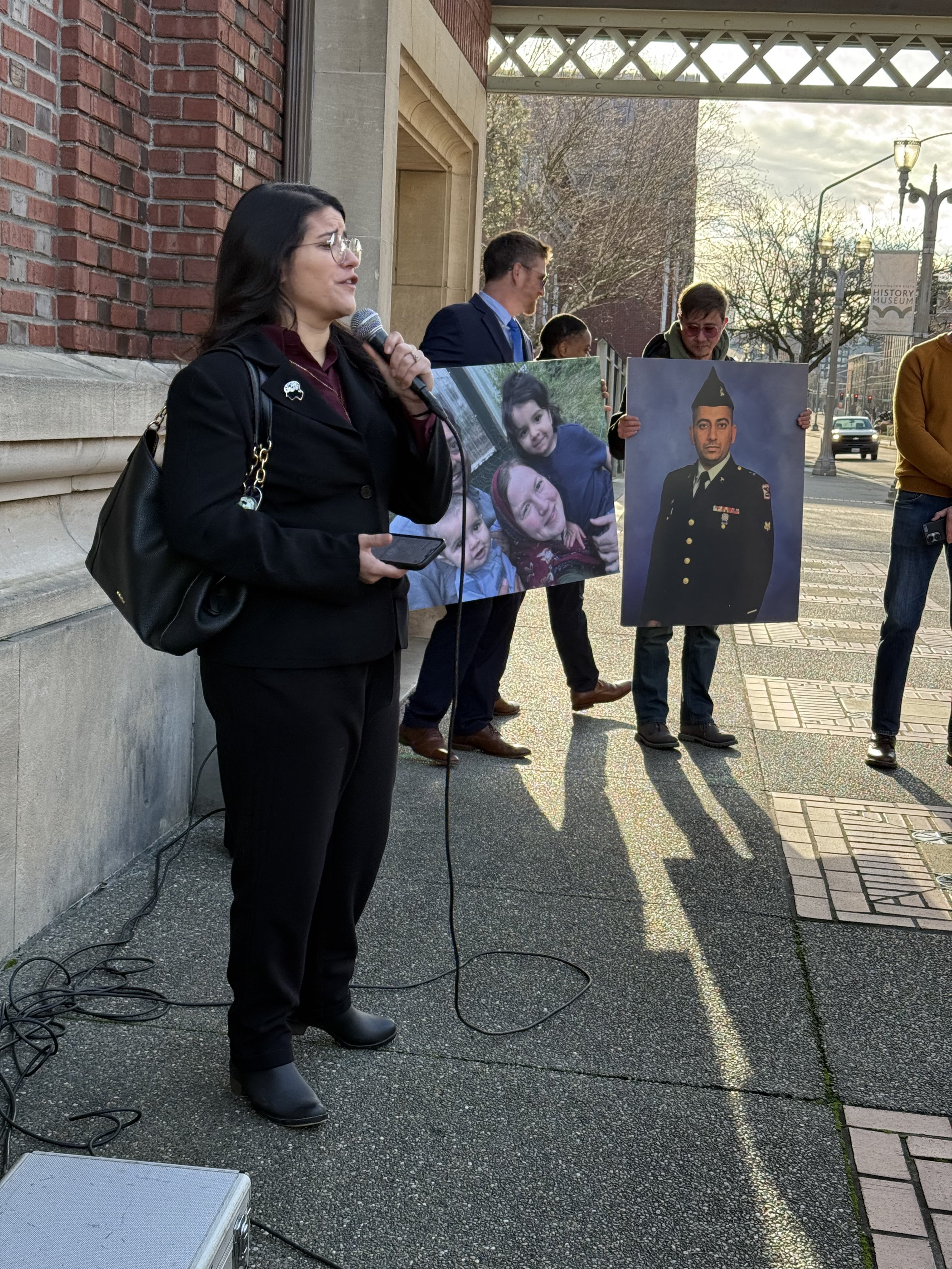
Micaela speaking at the press conference outside the court hearing ordering Zahid Chaudhry’s release.
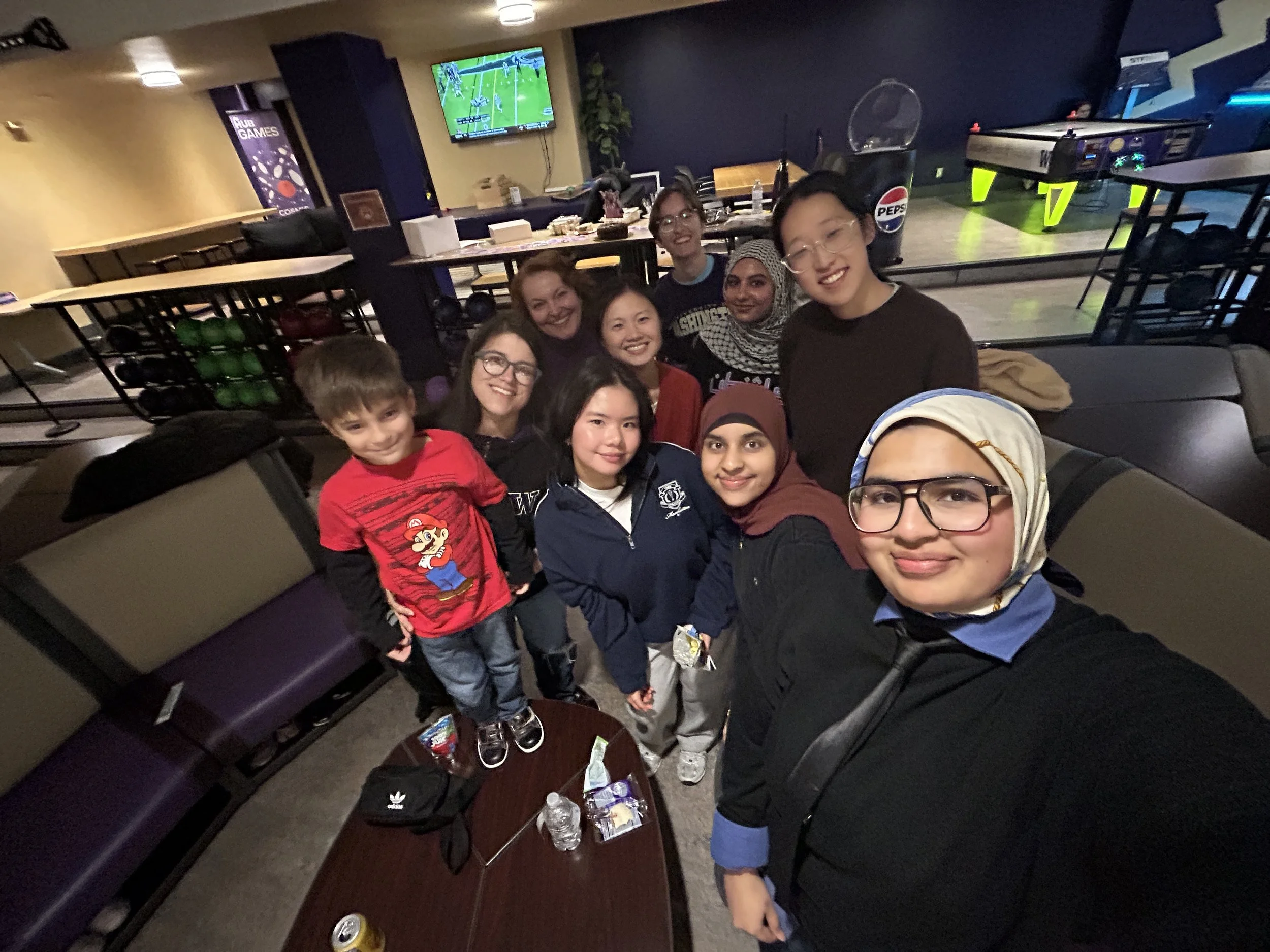
Dane’s 7th birthday with the Wang Lab at the HUB bowling alley.
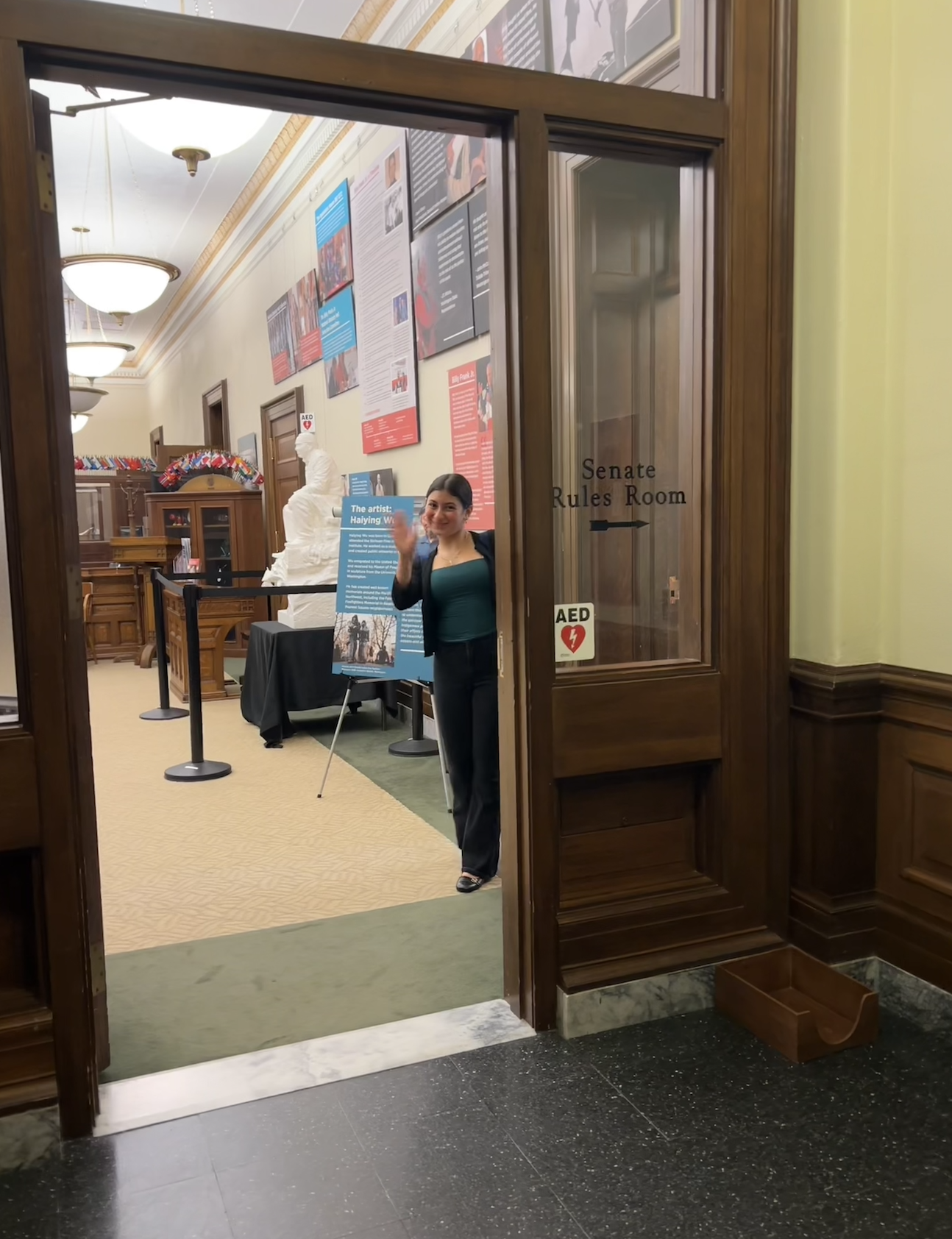
Dropping Samantha off for her first day on the Legislative Youth Advisory Council in Olympia.
There were many times in my life when I measured my growth by my lowest points, using hardship as the reference point for success. For years, it felt like I had to explain what I had overcome to justify where I stood. But this last year, I realized I no longer need to frame my standing through the lens of poverty or systemic failure to feel proud of my progress or deserving of the next great opportunity.
2025 was a season of exponential growth. It was the year that my perseverance compounded, and surviving “long enough” gave rise to a life that is finally able to bloom.
This year was full in a way that felt impossible to keep everyone updated on, so I wanted to share a more complete reflection of what unfolded and what’s coming next.
Academically, I achieved much that still feels surprising. I was accepted as a transfer student into the University of Washington, where I was awarded the Martin Family Honors & Achievement Scholarship and officially accepted into the Neuroscience major with a minor in Spanish. I finished my first quarter with strong grades and am excited to begin the first quarter of the Neuroscience program in the Winter.
One of my proudest achievements this year was continuing my reintegration research in the Wang Lab despite NIH funding cuts. It was intellectually demanding and emotionally personal work, but still, what I’m most passionate about. In the Spring, I added Aimel to my team, who had extensive research experience on multiple projects in the Wang Lab. This opportunity to lead and mentor a driven young scientist was an incredible learning experience that expanded my STEM mentorship. Ultimately, Aimel’s help was instrumental in moving my social isolation work forward over the summer. This was my second summer conducting research studying the neurobiological and behavioral impacts of social isolation, and this round, I focused on the impacts of reintegration post social isolation on social networks.
Over the summer, I had legislators like Senator Claire Wilson, Representatives Strom Peterson, and David Hackney come to the lab for lunch and learns, as well as several members of the Department of Corrections and the Office of Corrections Ombudsman, bridging science directly into policy conversations. These moments feel like a culmination of years of insisting that lived experience and research belong where decisions are being made.
2025 was also a year of rooting myself deeper into my local community and not just empowering others to engage in theirs:
I organized Covington’s first Pride celebration despite pushback from the City Attorney and City Leadership, and it was a beautiful, joyful success.
I became PTA Fundraising Chair at my son’s elementary school, building relationships between families, educators, and small businesses.
I supported our local council candidate, Riley Reed, knocking on doors, riding in parades, and watching her win in a landslide.
I coached T-ball for the first time, a reminder that the world sometimes changes in little hearts and dugouts, and not just in hearing rooms.
I helped pass the clemency and pardons reform bill and stood with Governor Ferguson at three bill signings.
I was nominated for the UW President’s Award for Civic Leadership
Participated actively as a Covington Human Services Commissioner to connect residents to local services.
My work grew, and so did I.
I had the privilege of mentoring four incredibly promising young scientists and advocates, each one a reminder of the beauty in our communities and unique goals.
Aimel’s work over the summer is what made my social isolation reintegration experiment possible. She came to my team in the Spring, and though we’re sad to see her leave the “Social Bees” team and the Wang Lab to prepare for graduation, we’re excited to see her graduate from UW in the Spring. Consistent, driven, and responsible, Aimel brings a sense of joy and purpose that improved our entire workflow.
Each mentee is special, and Elena is no different. We met at Bellevue College in Winter 2025, when she showed genuine interest in my research at UW and asked to shadow me sometime on a bumblebee brain dissection. We connected when I could tell she was incredibly bright and had a promising future in STEM. We were both UW transfer hopefuls, and once accepted into UW, my lab director, Dr. Wang, welcomed her into the lab and onto my team as a research aide. Elena is steady, inquisitive, and fearless in the way women of color in STEM often must be. Supporting her growth has been one of the most meaningful research experiences of my year. When research opportunities are few and far between, giving her a well-deserved opportunity and watching her knock it out of the park is one that I take tremendous pride in. I am looking forward to a long research partnership together and seeing what she accomplishes at UW.
Juwayriyah is peace, grace, and the most beautiful smiling face. She completed her time in the Wang lab, graduating from UW in the Spring and accepting a position as my intern at WashingtonCAN, focusing on healthcare communications and legislative advocacy for communities of color. I knew that she would be continuing her education and needed a bit of flexibility in a job. I knew that with research picking up, and my upcoming transfer into UW, I also knew I would need support at WashingtonCAN that she could fulfill, and would expand her skillsets and confidence. Watching her connect research, culture, and policy is incredible. Civic engagement should connect and unite us across so many areas. When Juwayriyah met Rep. Mia Gregerson outside of a court hearing for Zahid over the summer they reminded me that leadership comes in many decibels, both being women of fewer words and big impact.
Samantha, my first mentee from the University of Washington, and my girl so beloved, we’ve jokingly adopted! We met at the Center for Neurotechnology in July of 2024 when I was speaking to local high schoolers. She is now one of the brightest young leaders I know. This year, she was accepted into Washington’s Legislative Youth Advisory Council, hired as my intern at WashingtonCAN, and recommended by me for the Coolidge Scholarship, where they would be honored to have her as a scholar. Samantha challenges me to be the best version of myself, inspires me, and makes me a better researcher, communicator, and advocate. I am in awe of Sam’s heart, passion, and knowledge. She fought alongside our movement to Bring Zahid Home, bringing in personal and academic connections, and making it her heart’s mission to see him reunited with his family. If there’s been one thing I’ve done right in my time at UW, it has been connecting with this young lady and supporting her dreams. I am honored to have a page in the book she’s writing and the path she’s paving for herself.
They say give a man a fish, and they’ll eat for a day. Teach a man to fish, and they’ll eat for a lifetime, but I don’t want to teach these fishermen to fish just for themselves or their families. I want to train these fishermen to teach others how to fish. We can’t be a society that continues to fish for ourselves. I want Sam, Elena, Aimel, and Juwayriyah to not only have the skills to achieve their goals but also know how to empower others and teach others how to come through for themselves and their communities. Mentorship by a pay-it-forward model. I loved that mentorship wasn’t a side project this year; it became a central part of my identity. I became someone who empowers others’ brilliance and their voices, and in doing so, I know that they will each go on to inspire future leaders and mentees of their own.
The most transformative part of my year was fighting for the freedom of Zahid Chaudhry, a disabled U.S. Army veteran, husband, father, and one of the kindest and compassionate men I know. But this wasn’t “activism”, this was personal. Zahid’s wife, Melissa, has become a close friend. Their children call me Auntie. My home will always be a second home to them now.
Fighting for Zahid meant fighting for the people who were like my own family, who have faced deportation and detainment, and the wider immigrant community that faces fear and torment daily under threat of these conditions. It was in coming to the aid of the Chaudry family that they entrusted me with their kids and let me into the most vulnerable moments of their lives. It meant fighting for their family as my own, because they were no longer just friends and fellow advocates.
We organized, we strategized, we spoke at press conferences and interviews, we showed up in court, and we held each other through fear, hope, and outrage. Melissa and I now share a bond; we know what it means to have our families harmed, our loved ones taken, tortured, and detained, and we don’t take it lying down. We fought back, and we won. She freed Zahid.
Standing behind Melissa, holding their son as the judge declared Zahid would be released, watching a family finally breathe again — that moment rewired something deep in me. It proved that community is stronger than cruelty. Love is more strategic than any system built without it.
This victory wasn’t just legal. It was spiritual. We freed Zahid. Now to keep him home…
As I look forward to 2026, I enter the new year with a sense of momentum and support I haven’t felt before.
This Monday, I start the UW Neuroscience Program, a dream that once felt outside my reach. In two weeks, I’ll find out whether I’ve been selected as a UW President’s Student Civic Leader Award recipient, a nomination alone that feels surreal. The legislative session is ramping up, and I am ready and eager to jump in. I’ll be training activists of all ages with Indivisible Covington, continuing to strengthen local civic power. I’ll keep pushing the PTA fundraising program, because building community and making education fun is important for our next generation. Data extraction and analysis from my summer reintegration study will continue as I begin to imagine what my 2026 research project might become, and apply for new scholarships, especially those centered on mentorship.
2026 feels expansive, open, and bright. It feels like the first year I’m stepping fully into who I’ve been becoming, the scientist my community needs.
